
10 Calm Scripts for the Trickiest Screen-Time Moments
· 3 min read · Updated
If you've said "turn it off" five times today and now you're standing there negotiating with a 6-year-old like it's a hostage situation — you're not alone. And you're not parenting wrong. You're missing the script.
Most screen-time conflicts aren't really about the screens. They're about transitions. Kids who melt down at the end of an iPad session aren't refusing to give it up — they're flooded by the gear-shift betweenengagedandstop. Their brain hasn't loaded the next thing yet.
The fix is having pre-loaded language. Scripts you've practiced. Phrases that make the transition feel less like a slammed door and more like a soft fade.
Here are 10 we've used in our house. Pick the ones that fit your kid. Adapt the words. Just don't wing it next time.
1. Two minutes before screens go off (mid-session)
"Two more minutes, then we're saving the game and coming to dinner. Want to set the timer or should I?"
The "want to set the timer" gives them a small choice inside the bigger one — which can soften resistance.
2. When they ask "five more minutes" (the loop)
"I can see you're really into this. What's the next stopping point in the show?"
Acknowledges the immersion, reframes "more time" as "where can you finish naturally."
3. End of approved screen time
"Screens are done at 7. Would you rather read with me or build with blocks until bedtime?"
The "or" is the trick — give them two acceptable next things instead of asking them to choose between screens or nothing.
4. Morning — before the iPad whining starts
"First we're getting dressed and eating breakfast. After that, we'll see if there's time for a show before school."
Routine first, screens conditional. Don't promise screens — make them earned. It tends to get easier when the rule stays consistent.
5. Mealtimes — the screens-at-the-table fight
"Phones and tablets stay in the basket during meals. We can talk about [something fun they're into] instead."
The basket trick — a literal box on the kitchen counter where all family devices go — can work better than verbal rules. Visual = easier to stick to.
6. When they say "but everyone else gets unlimited screens"
"I hear you. Different families have different rules. In our family, this is what we do because we love how you feel after you're outside, building, or reading."
Don't argue the comparison. Acknowledge it, redirect to the why without lecturing.
7. Long car rides — when screens have run their course
"Last episode. After this we're going to play eye-spy or car karaoke for the rest of the drive."
Set the wrap-up before they're already three episodes deep. Mid-stream interruption hits harder than scheduled.
8. After-school — the "I just need to chill" trap
"I get it — you've been on for hours. Let's do 20 minutes of decompression any way you want, then we'll do screens together for half an hour."
Honour the need for transition. Trade passive-solo-screens forsomething else first, then screens-with-you.
9. Bedtime — the 'one more video' loop
"Bedtime starts at 8. Screens are off at 7:30. That gives you 30 minutes for teeth, books, and snuggles."
Be specific about the buffer. Kids handle "off at 7:30" better than "off when I say so." Predictability beats fairness.
10. The reset script — when nothing's been working
"I think our screen rules have gotten a bit messy. Want to sit down together this weekend and write new ones we both feel good about?"
The most powerful script isn't a phrase — it's an invitation. Kids who help write the rules have a stake in them.
The pattern
Notice what these scripts have in common:
- They acknowledge the feeling before redirecting
- They offer choice inside the boundary
- They avoid the word "but" (which kids hear as "ignoring me")
- They never lecture in the moment
Most screen-time fights happen because theparenthasn't decided what they want yet. The scripts help because the boundary is decided in advance — your kid just gets to pick how it lands.
Want printable script cards for the fridge?
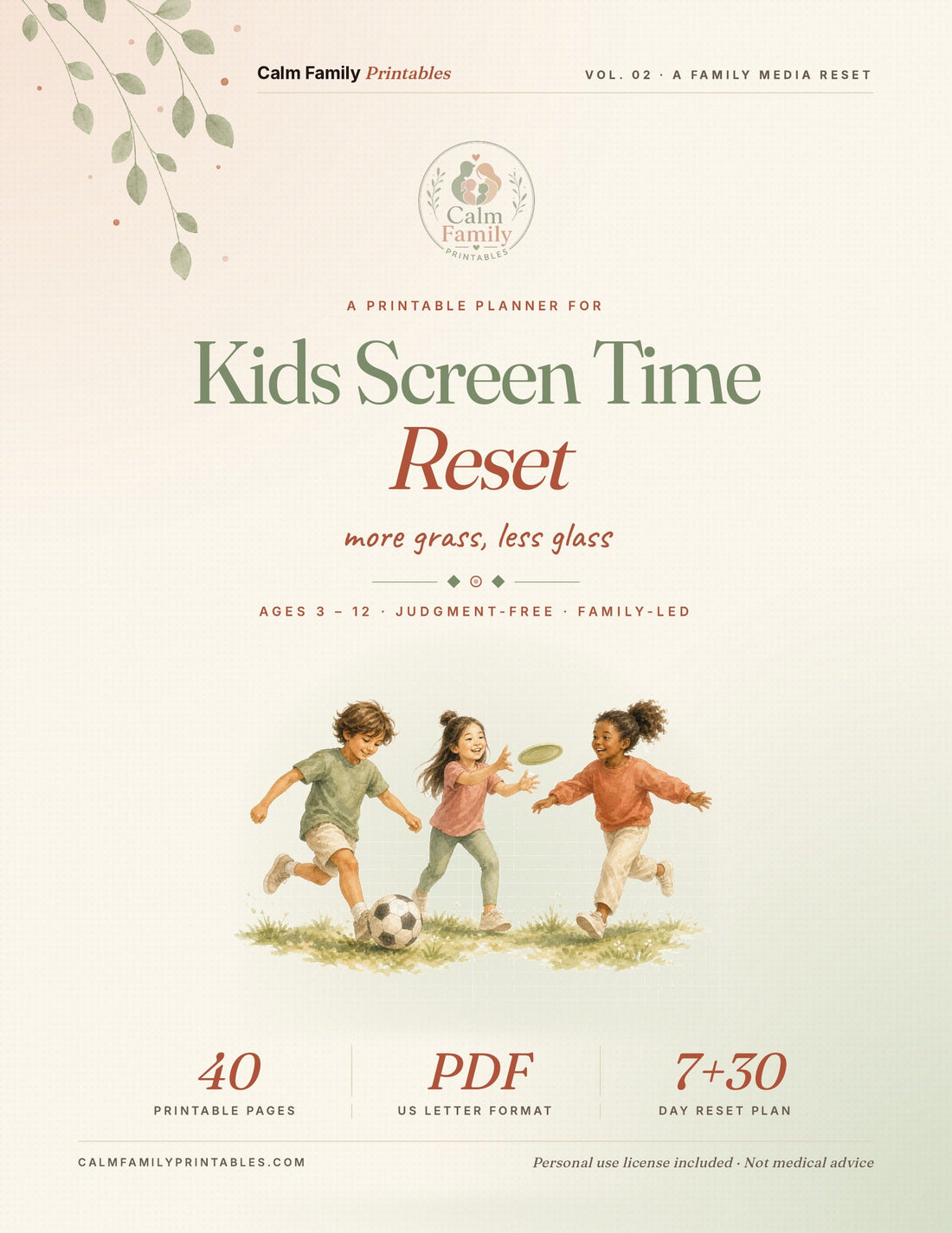
The Kids Screen Time Reset Workbook has 5 calm transition scripts for the trickiest moments, a 7-day reset plan, family agreement template, and daily tracker. 40-page printable PDF.
Then use the workbook's family agreement template to write your new rules together.
Part of the Calm Family Library — five printable workbooks in one bundle.