
Calm Down Corner or Calming Corner: How to Set One Up
· 12 min read · Updated
A calm down corner, also called a calming corner, is a quiet spot where a child can go when feelings get big. It can be a corner of a bedroom at home or a beanbag at the back of a classroom. This guide covers both: where to put it, what to put in it, and how to start. Start with our free printable calm down cards and free feelings chart.
Written by a mom of two, including an autistic son, who built her first calm down corner out of desperation and now runs the printables shop that grew out of it. No fluff, no theories. Just what helped at home.
What's Inside
- What a calm down corner actually is (and what it isn't)
- Why it can help
- Who needs one (the answer is most kids)
- Setting up the physical space
- The 8 essential tools every corner needs
- 10 calming strategies with parent scripts
- Age-by-age guide: toddler to tween
- A calming corner in the classroom
- Calm down corners for autism, ADHD, and sensory kids
- How to introduce it to your child
- 7 common mistakes that backfire
- Printables for your calming corner
- FAQ
What a Calm Down Corner Actually Is
A calm down corner is a designated physical space in your home, usually a small nook or corner, where your child can go to settle when they're overwhelmed, frustrated, sad, angry, or simply overstimulated. It is stocked with sensory tools, calming activities, and visual reminders of strategies they can use to feel better.
Here's what it is NOT:
- A time-out spot. Time-out is punishment. A calm down corner is the opposite.
- A place you send your child against their will. They go there because they want to feel better.
- A behavior chart in disguise. There are no rewards or consequences attached.
- A magic fix for big behavior issues. It's a tool, not a cure.
The single most important thing about a calm down corner is this: it is YOUR CHILD'S space, on YOUR CHILD'S terms. You can suggest going there. You can model going there. But the moment you start enforcing it, you've turned the calmest spot in your house into a punishment, and your child will refuse to use it.
Why It Can Help
When a child melts down, their whole body is on high alert, and thinking it through is very hard in that moment.
This is not a discipline problem. It's a moment of overwhelm. It's very hard to reason with a child in the middle of a meltdown, just as it's hard for any of us to think clearly when our feelings are running high. Talking it through can wait until they feel calmer.
What usually helps is a chance to settle. A calm down corner can offer three things:
- Reducing sensory input. A quieter, dimmer, less-busy space gives a child who feels overloaded a chance to settle.
- Adding regulating sensory input. A firm hug (if they want one), slow breathing, rhythmic movement, and soft textures can all feel soothing.
- Creating predictability. A child who has practised what to do has something to reach for when feelings get big.
A calm down corner can offer all three. That's the whole idea. Everything else in this guide is just the practical application of those three principles.
Who Needs a Calm Down Corner
The short answer: most kids from age 2 up can benefit from one, and some find it especially helpful.
If your child fits any of these, a calm down corner may be especially worth trying:
- Has meltdowns more than once a week
- Struggles with transitions (between activities, in and out of the house, before bed)
- Is diagnosed with autism, ADHD, sensory processing differences, anxiety, or any combination
- Comes home from school dysregulated almost every day
- Has big emotions and limited words to describe them
- Hits, throws, or destroys things when frustrated
And here's what most parents don't realize: a calm down corner is also valuable for kids who don't appear to "need" one. Every child experiences big feelings. The ones who don't show it on the outside are often holding it in until they get home. A calm down corner gives them permission to feel what they're feeling.
Setting Up the Physical Space
Forget Pinterest. Your calm down corner does not need to be aesthetic. It needs to be functional. Here is what actually matters:
Location
Pick a spot that is:
- Out of the main flow of household traffic (not the middle of the living room)
- Visible enough that your child doesn't feel banished, but private enough that they don't feel watched
- Close to where dysregulation typically happens (often near where homework gets done or near the family room)
- Free of sharp corners, breakable objects, or things they can throw
Common spots that work: under a staircase, a closet with the door removed, a corner of the bedroom, a section of the playroom, behind a couch with a small canopy.
The Container
You need some way to define the space. Options:
- A small pop-up tent
- A canopy hung from the ceiling
- A folding screen creating a partition
- Two large floor cushions creating an L-shape
- A blanket fort that stays up permanently
The container matters because the boundary between "regular space" and "calm space" is part of what makes it feel like a safe place.
The Floor
This is more important than parents realize. You need something soft enough to lie on, but not so soft that it's distracting. A faux sheepskin rug, a thick foam mat, or a 4-inch crash pad all work. Avoid: bare floor, anything slippery, anything with loud colors or patterns.
Lighting
Bright overhead lights can feel like a lot. Add:
- A small lamp with a warm-toned bulb (no fluorescent, no cool white)
- Or fairy lights (keep cords and batteries out of reach)
- Optionally a star projector for older kids (10+)
The 8 Essential Tools Every Calm Down Corner Needs
You don't need everything on Etsy. You need these 8 things, ideally organized so your child can grab what they need without asking.
- A soft blanket or favourite cuddly toy. Weighted products are not right for every child, so check with your child's doctor or occupational therapist before using one. A soft, familiar blanket or cuddly toy to snuggle is a lovely alternative.
- Something to fidget with. Tangle toys, stress balls, putty, fidget cubes. Different kids prefer different textures. Start with 3 options and see what gets used.
- Headphones (noise-cancelling) or earmuffs. For kids who are sound-sensitive, these can make the corner feel quieter. Choose a pair made for children.
- A feelings chart or feelings wheel. Most kids can't name what they're feeling in the moment. A visual gives them a way to point. Especially handy for kids under 8 and for any kid still finding their words. Print our free feelings chart, or see all our emotion cards.
- A calming strategy card set. Visual reminders of what to try (deep breathing, drawing, squeezing, drinking water). Many kids find strategies easier to remember when they can see them, not just hear them. Start with our free calm down cards, or see every move on our coping skills cards page.
- A water bottle. Sounds basic but matters. Sipping water through a straw can be a calming little ritual.
- Drawing supplies. A small clipboard with paper, washable markers, or a magnetic drawing pad. Drawing can be a calming tool, not just an art activity.
- A book or two. Familiar, soothing reads. Not new books. The point is comfort, not stimulation.
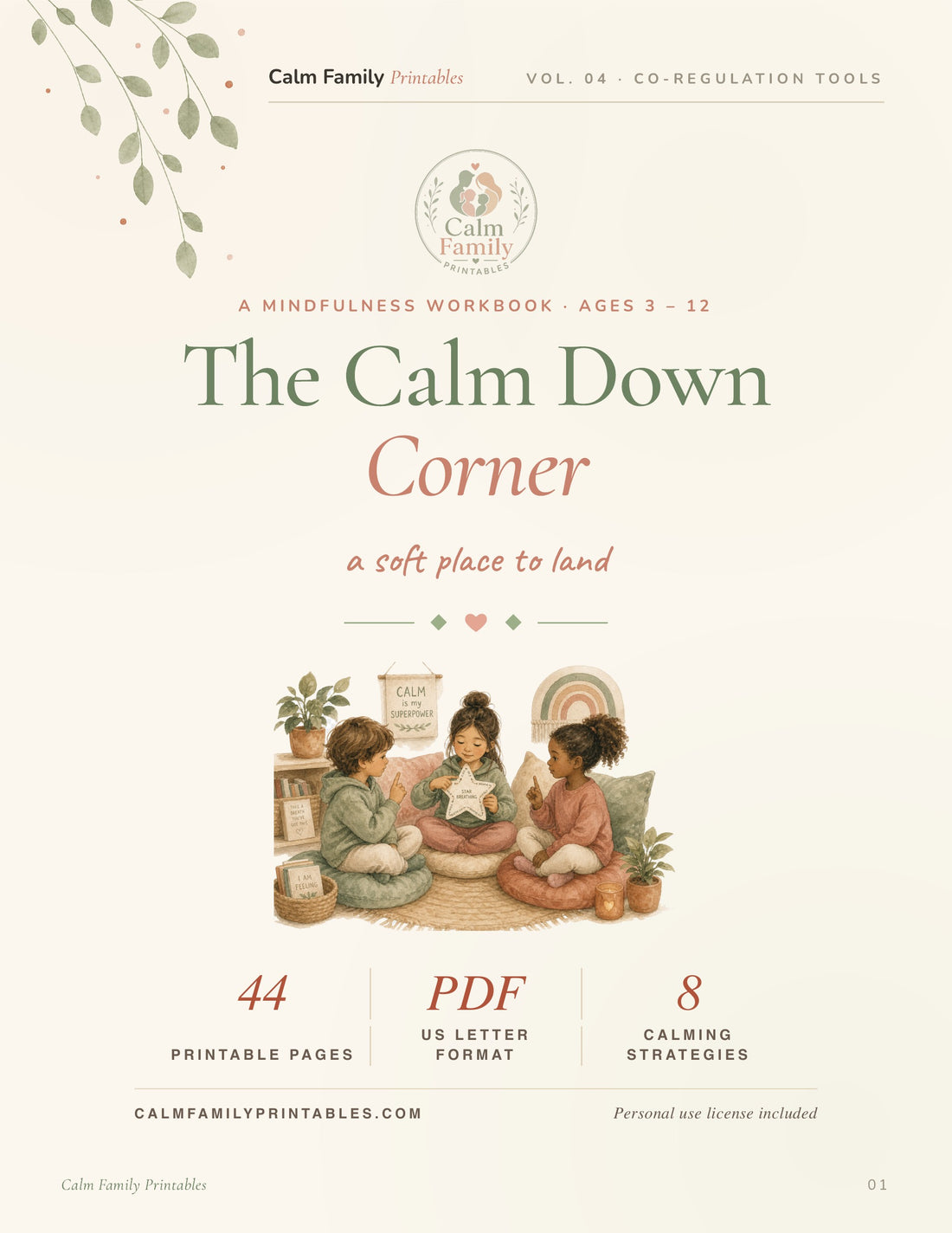
If you want the printable ones in one system, that's exactly what our Calm Down Corner Workbook is. Feelings wheel, 8 calming strategy cards, breathing exercises, body check-in pages, and a personal calm-down plan template, all designed for kids ages 3 to 12 and made first for the founder's own son.
Shop the Calm Down Corner Workbook (15% off with code WELCOME15)
10 Calming Strategies (With Parent Scripts)
Strategies are much easier to use when kids have practised them BEFORE the meltdown, not during. Run through these during calm moments. Then in the heat of the moment, you point to the strategy card and remind them.
1. Deep Belly Breathing
Hand on belly, breathe in through the nose for 4 counts, out through the mouth for 6.
Script: "Let's blow up a balloon in your belly. Watch your hand go up... and now slowly let the balloon out."
2. The 5-4-3-2-1 Grounding Exercise
Name 5 things you see, 4 things you can touch, 3 things you hear, 2 things you smell, 1 thing you taste.
Script: "Let's find 5 things in this room with our eyes. Just point at them. One... two..."
3. Bear Hug
Wrap arms around self, squeeze tight, hold for 10 seconds, release. Deep pressure on the body.
Script: "Give yourself the biggest bear hug you can. Squeeze as tight as a bear would. Hold... and release."
4. Cold Water on the Face
Splashing cool water on the face gives a fresh feeling to focus on for a moment. Grown-ups can try it too.
Script: "Want to try the magic trick? Splash some cool water on your face. See how it feels."
5. Stuffed Animal Squeeze
Hug a stuffed animal as hard as possible for 10-second intervals.
Script: "Give your bear a squeeze hug. Squeeze... and rest. Squeeze... and rest."
6. Drawing It Out
Draw the feeling. No "right" way. Just put it on paper.
Script: "Can you draw what the feeling looks like? Any colors. Any shapes."
7. The Wall Push
Stand facing a wall, press hands flat against it, push as hard as possible for 10 seconds. Proprioceptive input.
Script: "Let's try pushing the wall down. Push as hard as you can. Hold it... now rest."
8. Cold Object Hold
Hold a cool pack wrapped in a cloth, or a cool (not frozen) water bottle, against the chest, palms, or back of the neck.
Script: "Here is a cool pack wrapped in a cloth. Hold it in your hands for a little while."
9. Slow Counting
Count slowly to 20, or backwards from 20. The counting itself can be soothing.
Script: "Let's count to 20 slowly together. One... two... three..."
10. Quiet Time With Music
Pre-loaded calming playlist on a small speaker. No headphones required for this one (music + room ambient is better than music sealed in ears).
Script: "Want me to put on the calm music?"
Age-by-Age Guide
Toddlers (2-3 years)
At this age, calm down corners are really "co-regulation corners." Your toddler can't self-regulate yet. The corner gives YOU and your toddler a place to go together. Stock it with a soft floor, a favourite cuddly toy, board books, and a simple feelings chart (4 emotions max). Sit with your toddler. Name what they're feeling. Wait it out together.
Preschoolers (4-5 years)
Now the corner becomes a partnership. Your child can start to self-direct toward strategies, but still needs your presence. Add fidgets, a feelings wheel, drawing supplies, and 2-3 strategy cards. Practice the strategies during calm moments. Read books in the corner so they associate it with comfort, not just dysregulation.
Early School Age (6-8 years)
This is the sweet spot for calm down corners. Kids this age can use them independently but still need parent involvement. Add the full toolkit (all 8 essentials). Co-create a "calm down plan" together: what to try first, second, third. Hang it on the wall of the corner.
Tweens (9-12 years)
Older kids resist anything that feels babyish. Reframe the space as a "reset zone" or "chill spot." Remove the visually-kid items. Add: noise-cancelling headphones, a notebook for journaling, a yoga mat, dim lighting. Treat them like the young adults they're becoming. Don't enforce use, just have it available.
A Calming Corner in the Classroom
A calming corner can go in a classroom too. Keep it small and in view: a beanbag or a cushion, a basket with two or three things to hold, and a few picture cards on the wall so a child can point to what they want to try.
Show the whole class how it runs on a calm day. Agree on a signal a child can give to go there, how long a visit lasts (a sand timer helps), and what happens when they come back. One child at a time suits most rooms.
Our page for teachers, Calmlings for classrooms, has more ideas, from feelings check-ins to movement breaks.
Calm Down Corners for Neurodivergent Kids
For many autistic, ADHD, and sensory kids, a calm down corner can be a real help, a bit like a ramp for someone who needs one. It gives them a place to settle that's set up around what they need.
Autistic Kids
Sensory needs are usually more specific. Some autistic kids need MORE input (crash pads, firm hugs, wall pushes). Others need LESS (noise-cancelling, dim lighting, no patterns). You may need both, in zones. Visual schedules and clear, predictable use of the space are critical.
The founder of Calm Family Printables built our Calm Down Corner Workbook for her own autistic son first. The visual cards, low-text design, and predictable structure were all shaped around his needs.
ADHD Kids
Many kids with ADHD find it easier to settle when they can move. A calm down corner for them might include a wall push spot, a yoga ball or wobble cushion, and movement-based strategies (jumping jacks, push-ups). The "calm" in calm down corner doesn't mean "still." For ADHD kids, regulated often involves moving.
Sensory Processing Differences
Notice what your child needs. Sensory seekers often enjoy: crash pads, firm hugs, and heavy work like carrying cushions or books. Sensory avoiders want: dim, quiet, soft, predictable, with escape routes. Many kids are both depending on the day. The corner needs to flex.
How to Introduce It to Your Child
The introduction matters more than the setup. Here is one way to start the conversation:
"I want to show you something we're making together. It's called a calm down corner. It's a special place for when you have big feelings. The cool thing is, no one is in trouble in this spot. No one goes there because they did something wrong. We go there to feel better."
Then: build it together. Let your child help choose the stuffed animal, the rug, where it goes. Their ownership is the magic. Then practice using it during a calm moment, not a meltdown.
Use it yourself. Kids learn a lot by watching us, and seeing you use the corner helps it feel normal. Adults need regulation too. Model it. "Mommy is going to the calm corner for a minute. I'm feeling overwhelmed and need to reset."
7 Common Mistakes That Backfire
- Calling it "time-out." Or letting your kid hear you call it that. It's a different idea, and it feels different to a child.
- Sending them there as punishment. Once. That's all it takes to ruin the association.
- Asking them to "calm down" while they're in it. They can't, and you saying it makes it worse. Just be present. Be quiet. Wait.
- Making it too pretty. Aesthetic corners often have too much in them, too organized, too precious. Function over form. Always.
- Skipping the practice phase. If the first time you introduce strategies is during a meltdown, they'll be much harder to use.
- Removing privileges if they don't use it. Forcing use makes the space unsafe. Once unsafe, useless.
- Giving up after a week. It can take several weeks for a calm down corner to become a habit. Stick with it through the awkward phase.
Printables for Your Calming Corner
A calming corner needs pictures as well as things: a way to name a feeling, and a few calming moves to choose from. Start with the free ones.
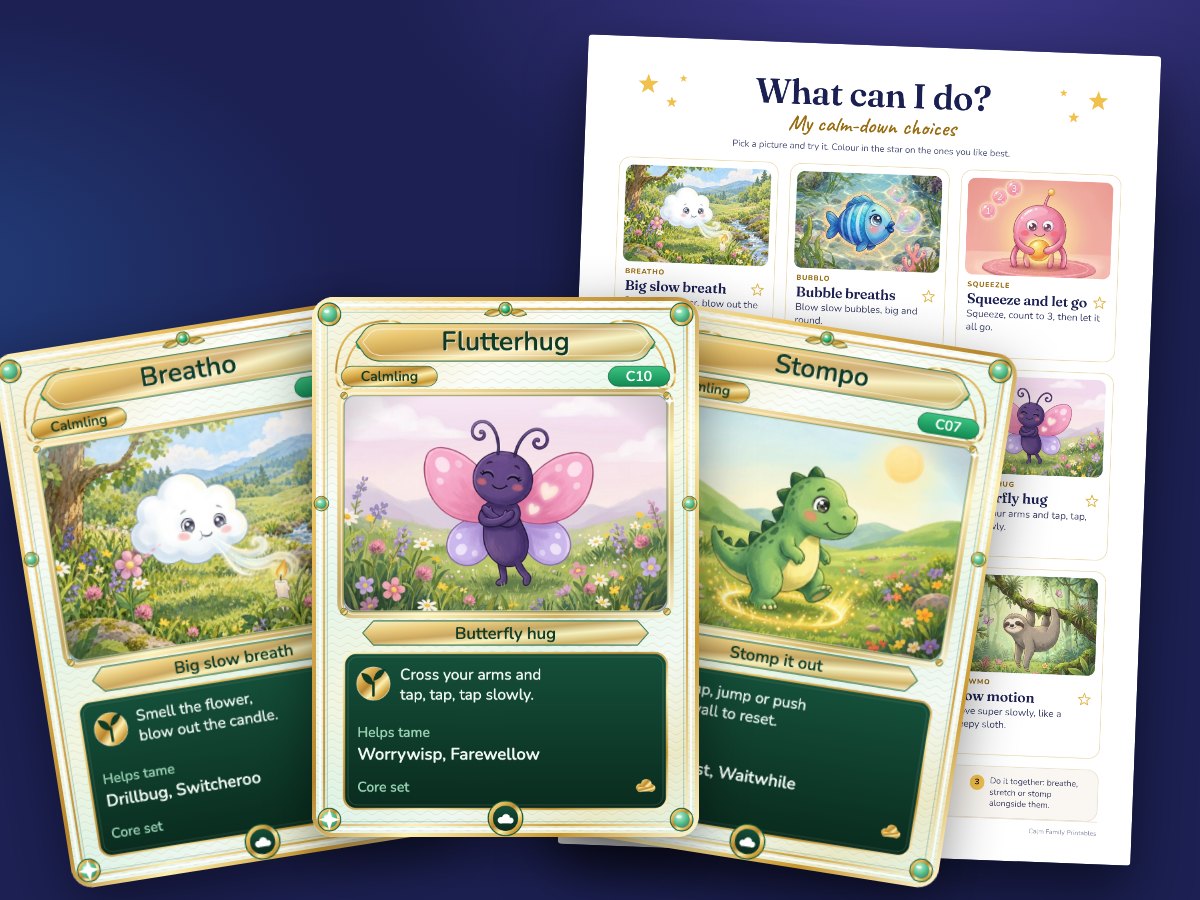
Calm-down cards
FreeNine calming moves on picture cards, plus a “What can I do?” poster.
See the free pack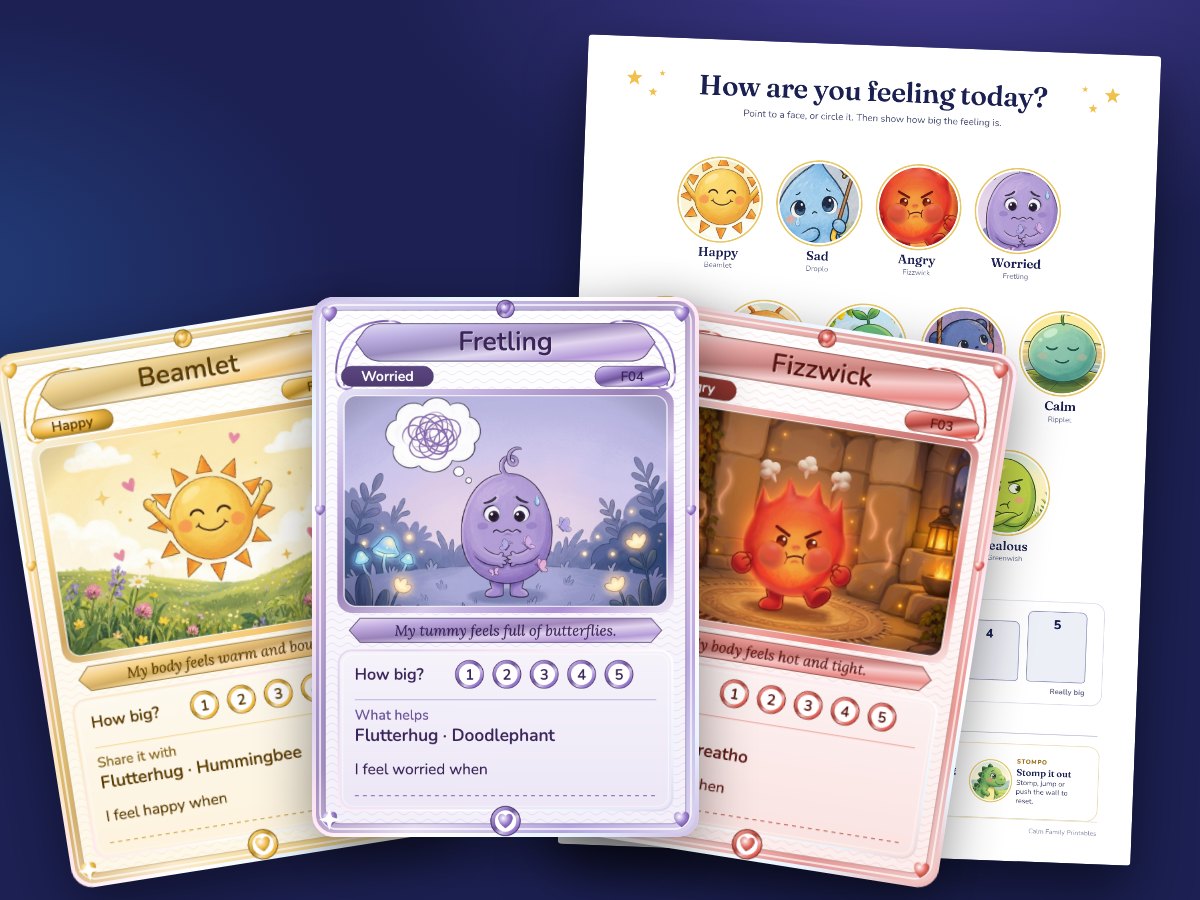
Feelings chart and cards
FreeThirteen feelings faces with a 1 to 5 scale, plus six feelings cards and three Calmlings.
See the free pack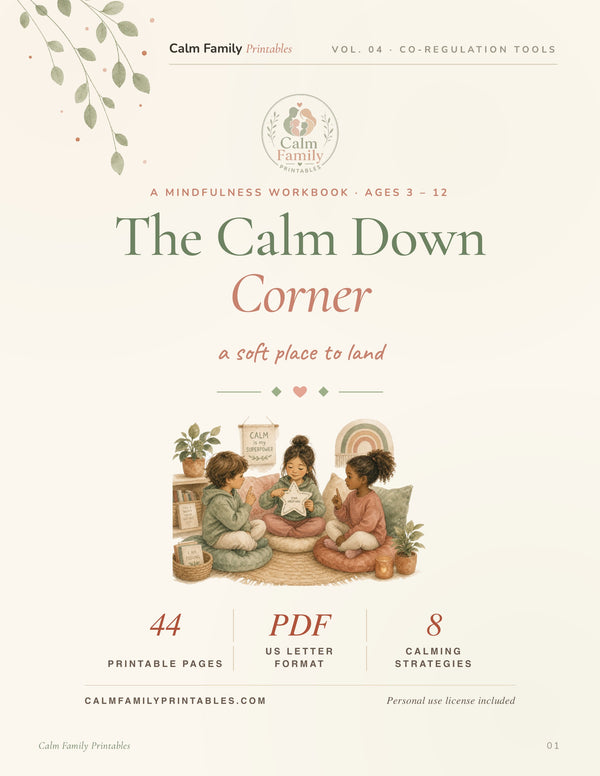
The Calm Down Corner Workbook
US$14A soft place to land: 8 calming strategies for big feelings.
View workbookThe free calm down cards have nine calming moves and a “What can I do?” poster. The free feelings chart has feelings faces and a 1 to 5 scale. The Calm Down Corner Workbook (US$14) adds a feelings wheel, breathing pages and a calming strategies poster. For every calming move as a picture card, see our coping skills cards. Packing a box to go with the corner? Here is how to make a calm down kit.
Frequently Asked Questions
How old should my child be to use a calm down corner?
From age 2 onwards, with adjustments. Younger kids need you in the space with them. Older kids use it independently. There is no upper age limit. Teens benefit from one too, just don't call it a calm down corner.
What if my child refuses to use it?
Don't force it. Model it. Use it yourself. Read books in it during calm times. Make it the most comfortable spot in the house. They will come around when it feels like theirs and not yours.
How is this different from a time-out?
Time-out is exclusion as punishment. The calm down corner is invitation toward regulation. The kid CHOOSES to go. The vibe is comfort, not consequence. It feels completely different to a child.
Can siblings share a calm down corner?
Yes, with clear rules: one kid at a time, the other waits, no fighting over tools. Better still: build two simple corners in different rooms. For siblings with very different sensory needs, you almost have to.
What if my child destroys things in the corner?
This is feedback. Either the tools are wrong (try less stimulating ones), the strategies haven't been practiced, or your kid is at a dysregulation level beyond what the corner can solve right now. Stay close. Adjust.
Do I need to buy printables to make a calm down corner work?
No. You can make your own from scratch. The reason families use printables is because they save hours of design work, are visually consistent (which many kids find easier to follow), and are ready to print. Optional, not required.
Is a calming corner the same as a calm down corner?
Yes. Calming corner, calm down corner and calm corner all mean the same thing: a quiet spot a child can go to when feelings get big, at home or in a classroom.
What goes in a calm down kit?
A kit is the part you can carry: a few things to squeeze, hold, look at and breathe with, plus picture cards of calming moves. See how to make a calm down kit.
The Bottom Line
A calm down corner is not a Pinterest project. It's a small, lasting change in how your home makes room for big feelings. Done with care, it gives your child somewhere to go when feelings get big, and gives you both a way back to each other.
Build it simply. Practice it often. Model it yourself. Stick with it past the awkward phase. The skills your child practises there now are skills they can keep building on as they grow.
The Calm Down Corner Workbook
If you want to skip the design work and get straight to the corner, our printable Calm Down Corner Workbook has many ideas from this guide in ready-to-print format. Feelings wheel, 8 calming strategy cards, breathing exercises, body check-in pages, parent guide, and a calm-down plan template your child fills in.
Designed by an autism mom for her own son before it was ever sold to anyone else.