
30 Screen-Free Activities for Kids (Printable Activity Cards)
· 5 min read · Updated
The 4pm Witching Hour Has a Solution (and It's Not the iPad)
It's 4:17pm. You've been "almost done" with one task for forty minutes. Your kid has asked for the iPad three times. The third ask had a whine in it. The fourth one is going to have a meltdown attached.
You know what comes next. You hand it over. You feel a little defeated. They go quiet, and you get fifteen minutes of peace that costs you about an hour of regret.
If you've lived this exact scene more than once this week, you're in good company. Lots of parents lean on screens every day just to get things done. Plenty of us hand over a screen to head off a meltdown, and plenty of us worry about how much time our kids spend on screens.
The problem isn't that you're a bad parent. The problem is that in the moment, your brain has to invent an alternative on the spot, and decision fatigue at 4pm is real.
So here's the fix: take the decision out of the moment.
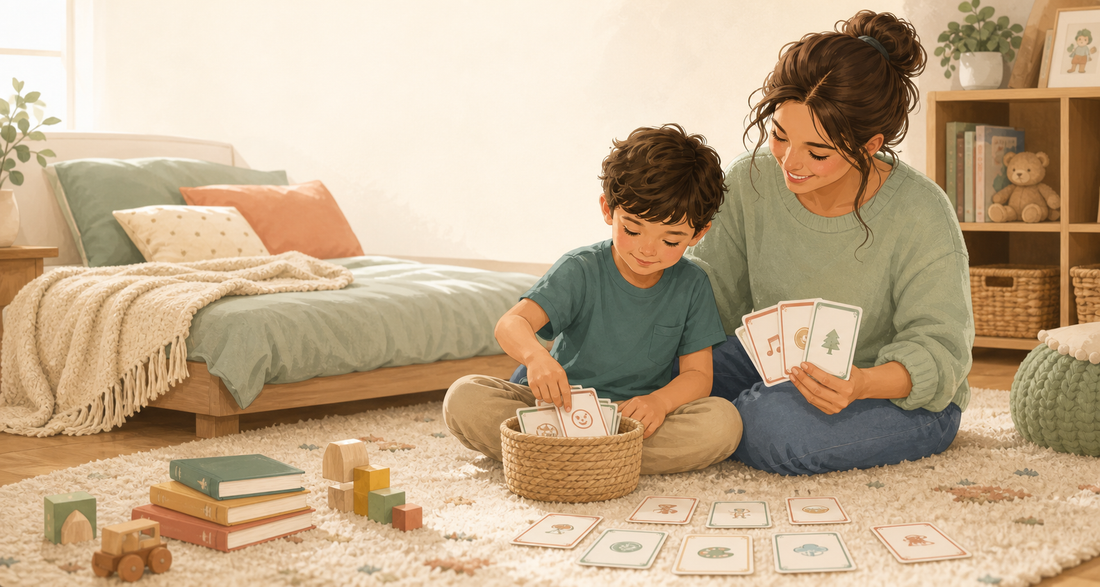
Below are 30 screen-free activities for kids ages 3–12, organized by time and energy level. Print them, cut them, drop them in a jar. When the iPad request hits, hand over the jar instead. Your kid pulls a card. The decision is already made, and it feels like a treat, not a punishment.
(There's a printable card deck at the bottom of this post if you want a head start.)
How to Use This List
The 30 activities are sorted into 5 categories so you can grab the right one for the moment:
- QUICK WIN (5 min) — for the "I'm bored" reflex
- SOLO PLAY (15 min) — for when you need to finish one thing
- TOGETHER (30 min) — connection time, no chaos
- OUTDOOR — fresh-air resets
- SENSORY — hands-on play
One trick that can help: don't suggest an activity. Hand them the jar. Pulling a card feels like making a choice; being told to do something feels like a chore. Same activity, totally different reception.
QUICK WIN — 8 Activities Under 5 Minutes
For when they're bouncing off the walls and you have one minute to redirect.
- Build a tall tower with whatever's on the table. Coasters, cups, books, fruit, whatever's there.
- Act like an animal. They act, you guess in three tries. Then swap.
- Find 5 blue things in this room. (Swap the color daily. Surprisingly addictive.)
- Make a secret handshake with three steps. Bonus: it becomes your goodbye-at-school ritual.
- Balance a book on your head and walk to the door. Add a plastic cup on top if they're feeling brave.
- Beat the timer — put away ten things in two minutes. This one is a Trojan horse and you know it.
- Tell a tiny story using only three sentences. Beginning, middle, end. Go.
- Draw with eyes closed, then guess what it is. The wronger the better.
SOLO PLAY — 7 Activities for 15 Minutes of Independent Play
For when you need to answer that email, take a phone call, or just finish your coffee while it's still hot.
- Build a pillow fort with pillows, blankets, and chairs. The setup is the activity.
- Draw a treasure map of your bedroom. They will reveal hiding spots you didn't know existed.
- Fold 3 paper planes — design a fleet. Folding instructions are optional and overrated.
- Write yourself a letter to open in one year. Stash it somewhere safe and put a calendar reminder on your phone.
- Sort toys by color into rainbow order. Surprisingly meditative.
- Build a block tower as tall as you can. Engineering, gravity, and ego in one package.
- Dress up for a job — pick someone with a totally different career. Astronaut, chef, dog walker, mayor.
TOGETHER — 7 Activities for 30 Minutes of Connection Time
For the connection time you keep saying you want more of, but never plan in advance.
- Bake something yummy from scratch — let them measure everything. Yes, it'll be messy. That's the point.
- Make a treasure hunt with five clues. Hide a small prize at the end. Snack-sized works.
- Play pretend store using pantry items as the merchandise. They're the cashier, you're a difficult customer.
- Read a chapter together, taking turns. A page each, two pages each, whatever works.
- Build an obstacle course through the living room. Time it. Beat the time. Repeat.
- Invent a board game using paper and household objects. The rules will be unhinged. Lean in.
- Have a dance-off — everyone picks one song. Phone on the speaker, lights down, judgment-free zone.
OUTDOOR — 4 Fresh-Air Resets
For when the indoor energy has nowhere to go.
- Find shapes in clouds. A lovely slow moment outside.
- Collect different leaves on a short walk. Press them in a heavy book at home for a second activity later.
- Draw with sidewalk chalk. No theme, no rules. Just chalk and concrete.
- Play hide and seek in the yard, three rounds, switch roles. Classic for a reason.
SENSORY — 4 Hands-On Activities
For when they're wound up and need something to do with their hands.
- Make a sensory bottle with rice and food coloring. Layered colors, lid glued shut, a calm-down bottle to shake and watch again and again.
- Make a playdough creature — the strangest one you can. Let weird win.
- Paint with water on the sidewalk. Watch them disappear. Repaint. Zen.
- Build a sand kingdom out of kinetic sand or playdough. Towers, moats, dragons, the works.
The Activity Jar System (the Part That Does the Deciding)
Here's the thing nobody tells you: a list of activities is useless when you actually need it. You're not going to remember "treasure map of the bedroom" at 4:17pm when your kid is unraveling. You're running on empty.
That's why the jar helps. The decision is pre-made.
Here's how to set it up in 10 minutes:
- Print the activities. Either use the printable card deck below (30 ready-to-go cards), or just write each activity on a sticky note or index card.
- Cut them apart.
- Drop them in a jar, basket, or envelope. Label it whatever feels fun: Activity Jar, Boredom Buster Box, The Magic Deck.
- Put it somewhere visible. Counter, coffee table, bookshelf.
- The next time they ask for a screen, point to the jar first. "Pick two cards. Then we can talk about screens."
That's it. No lecture, no negotiation. The jar does the deciding for you.
Get the Printable Card Deck
If you want this done instead of to-do, the Screen-Free Activity Cards are a print-ready PDF — 30 screen-free activities laid out as designed cards with illustrations, color-coded by category, with cut lines and a parent guide. You print, cut, and drop in a jar. 10 minutes from download to working system.
Get the Screen-Free Activity Cards → US$14, instant PDF download.
You can also bookmark this post and use the list above for free. The cards just save you the design and printing-prep work, and they're designed to look inviting.
Either way: make the screen-time decision before the moment comes. Set up the system once, and reach for it for years.