
Chore Charts for Kids: A Parent Guide
· 10 min read · Updated
This is our step-by-step guide to setting up a chore chart that fits real family life. Written by a mum of two who tried sticker charts, reward systems, magnetic boards, and apps before figuring out what actually sticks. No Pinterest fantasy, no rigid systems that crumble in week two. Just the real playbook.
What's Inside
- The truth about chore charts (and why most fail)
- Why chores matter
- Age-appropriate chores for every age
- 5 chore chart systems compared honestly
- How to set up your chart in one weekend
- How to enforce without daily battles
- Should you tie allowance to chores?
- Chore charts for autism and ADHD kids
- 8 common mistakes that backfire
- FAQ
The Truth About Chore Charts
Most chore charts last about two weeks before they get ignored. Then a year later, the parent tries again with a new system, and that one lasts two weeks. Then another year, another system.
The reason isn't that kids hate chores or parents are inconsistent. It's that most chore charts are designed for a Pinterest photograph, not a real family. Twenty laminated tasks, color-coded magnets, a sticker for every completion. Beautiful for week one. Unmaintainable by week three. The parent quits. The kid concludes chores don't actually matter. Worse than before.
The chore charts that work share specific design choices:
- They start small (3-5 chores, not 15)
- They're visible in the same spot every day
- They have clear "done" markers (cards to move, checkboxes, magnets)
- They flex for real life (sick days, weekends, special events)
- They get held by parents through the protest phase (days 3-7)
- They're reviewed monthly and adjusted
Get those six things right and most chore charts work, regardless of style. Get any one of them wrong and the most beautiful chart on Etsy will fail.
Why Chores Actually Matter
Many parents find that children who do chores from as young as 3 or 4 grow in confidence and feel more a part of the family.
Not because they learned to scrub a toilet. Because they learned three things chores teach better than anything else:
- Contribution. The feeling that you're a needed member of a group, not a guest. Kids who feel needed by their family can build a sense of competence that carries into other parts of life.
- Delayed gratification. Doing a thing now to maintain something later. The kid who learns to put dishes away learns the meta-skill of "I do effort now, life is better later."
- Self-efficacy. The belief "I can do hard things" comes from doing hard things, not from being told you can. Chores are the cheapest available training ground.
The chore itself is not the point. The chore is the medium for teaching the meta-skills. That's why chores done imperfectly still count. The trying is the lesson.
Age-Appropriate Chores for Every Age
The biggest reason chore charts fail is assigning chores that don't match the kid's developmental stage. Too easy and they're bored. Too hard and they fail and conclude they're bad at it. Here's what actually fits each age.
Ages 3-4 (Toddler/Preschooler)
- Put toys in the toy bin
- Help feed pets (supervised)
- Wipe small spills with a cloth
- Put dirty clothes in the hamper
- Match socks from the laundry
- Set out their own shoes by the door
Realistic expectation: 50% completion, lots of help, the chore takes 3x longer than if you did it yourself. The point is the CONCEPT.
Ages 5-6 (Kindergarten/Early School)
- Make their bed (loose definition)
- Put away their own laundry
- Feed pets independently
- Set the table
- Clear their plate after meals
- Help sort recycling
- Water plants
- Wipe bathroom counter
Realistic expectation: visual reminders required. Picture cards work better than verbal instructions at this age. 2-4 chores total is plenty.
Ages 7-9 (Middle Elementary)
- Make bed properly
- Manage own laundry start to finish (with reminders)
- Empty dishwasher
- Take out trash
- Vacuum their room
- Pack their school bag
- Tidy bathroom
- Walk dog (with adult)
- Help prep dinner
Realistic expectation: this is the chore sweet spot. Kids capable and (mostly) willing if the system is fair. 4-6 chores work well.
Ages 10-12 (Tweens)
- Full laundry management (own clothes)
- Make simple meals
- Clean bathrooms properly
- Help in the garden (raking leaves, weeding, sweeping paths)
- Wash dishes
- Vacuum whole house
- Help keep an eye on younger siblings (with an adult at home)
- Pet care fully independent
Realistic expectation: tweens can do almost anything an adult can. The challenge is motivation and consistency. This is where tying chores to phone privileges or allowance starts to make sense.
Ages 13+ (Teens)
- All household chores at adult competence
- Plan and cook meals weekly
- Manage own schedule and laundry
- Babysit siblings
- Maintain own bedroom and bathroom
- Contribute to family meal planning
- Light home maintenance
Realistic expectation: teens benefit from chores framed as adult-prep, not punishment. Tie chores to the freedoms they want. Use written agreements rather than parental reminders.
5 Chore Chart Systems Compared Honestly
1. Sticker Charts
Best for: Ages 3-7. Skip if: Kid older than 8. Verdict: Works for short bursts. Loses effectiveness over time as the novelty fades. Don't use beyond a year.
2. Magnetic Chart with Movable Pieces
Best for: Ages 4-10. Skip if: Family doesn't have a magnetic surface in a useful spot. Verdict: One of the best systems. The physical act of moving a magnet from "to do" to "done" is part of why it works. Worth the small investment.
3. Whiteboard System
Best for: Ages 8+ through teens. Skip if: Kid is pre-reader. Verdict: Flexible, low-decoration, doesn't feel babyish. Best transition system for kids outgrowing picture charts.
4. App-Based Systems (chore and pocket-money apps)
Best for: Tech-comfortable families with kids 9+. Skip if: You don't want another app to manage. Verdict: Works great for some families. Gets abandoned by week three for most. The maintenance cost is the killer.
5. Printable Workbook with Picture Cards
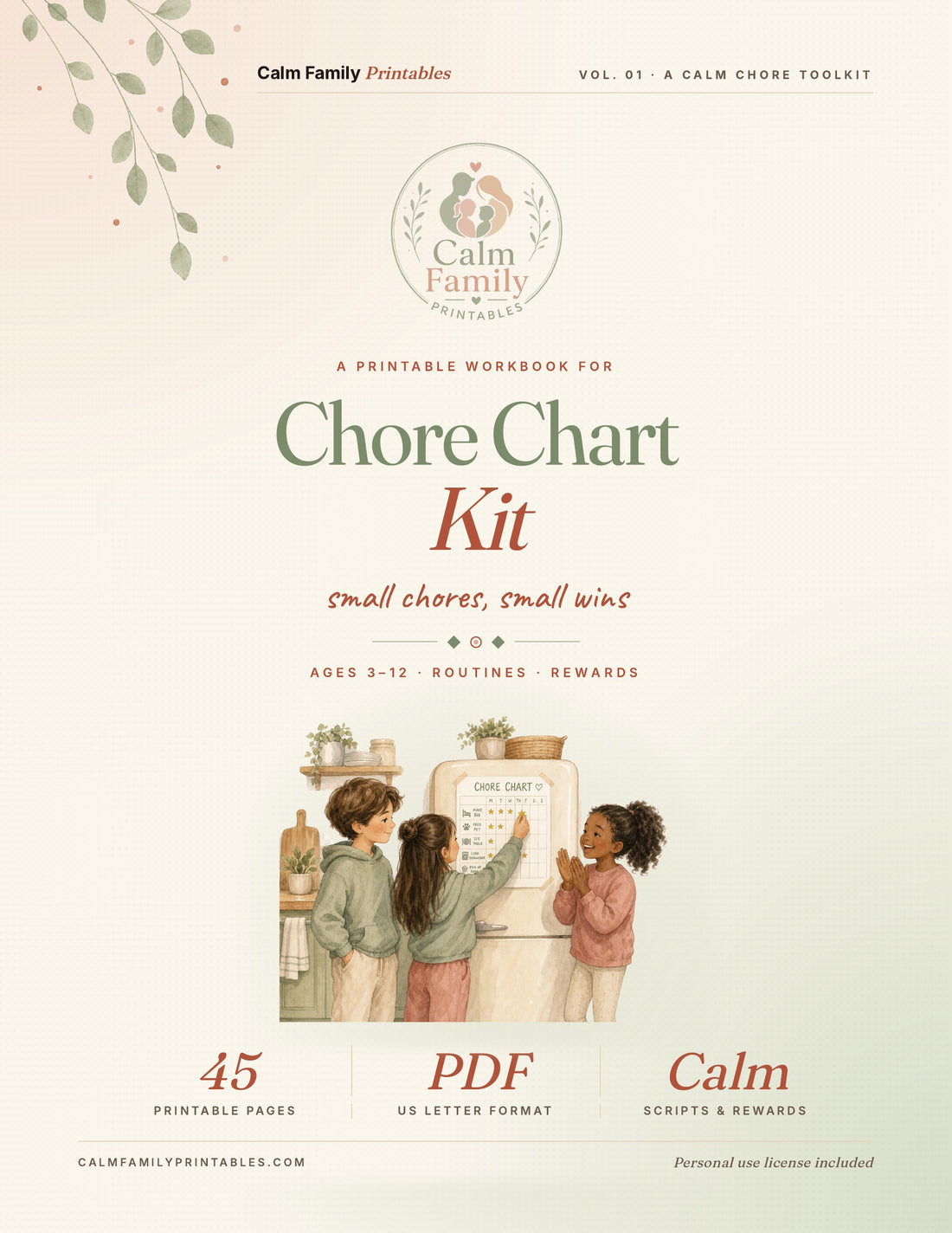
Best for: Ages 3-12, mixed-age families. Skip if: Kid is teen. Verdict: Flexible, customizable, works for non-readers. Our Chore Chart Workbook is this style — 24 picture cards across everyday chores, weekly tracker, and a family meeting template for talking chores through together.
Shop the Chore Chart Workbook (15% off with code WELCOME15)
How to Set Up Your Chart in One Weekend
Saturday Morning (30 minutes)
- Family meeting. Everyone in the kitchen. Explain: "We're starting a new chore system. Here's why. Here's what." Get input. Make small adjustments based on it.
- Pick the chores. 3-5 to start. Don't aim for 10. Less is more.
- Pick the chart format. Magnetic, paper, whiteboard, app. Whatever you'll actually maintain.
Saturday Afternoon (1 hour)
- Build it. Print the chart, set up the board, install the app, whatever the format needs.
- Put it in the right spot. Kitchen counter, hallway, kid's bedroom door. Somewhere the family passes daily.
- Demo it once. Walk through how it works. Move a magnet. Check a box. Show what "done" looks like.
Sunday (Family agreement signing)
- Sign the agreement. Even verbal agreement counts. Make it feel official.
- Set the start time. Tomorrow morning. Not "we'll see."
- Schedule the first review. "Three weeks from today, family meeting to see how it's going."
Done. Three hours of work over a weekend = a chore system that, if you hold it, lasts years.
How to Enforce Without Daily Battles
Enforcement is where most chore systems break. The wrong approach: nagging, lecturing, punishing for incomplete chores. The right approach: structural enforcement that doesn't require your emotional energy.
The 3 Rules of Sustainable Enforcement
- The chart is the boss, not you. When your kid asks "do I have to clean my room?", point at the chart. "What does the chart say?" Removes the parent-kid conflict.
- Natural consequences over imposed ones. Didn't put laundry away? Wear wrinkled clothes tomorrow. Didn't feed the dog? Dog finds you and demands attention. The world enforces; you don't have to.
- Predictable consequences for repeated misses. "Chore not done = no screen time today" is more effective than "huge punishment if you miss three days." Smaller, more consistent.
The Daily Routine That Works
- Morning: Kid checks chart, sees what's expected today.
- After school / before screen time: Chores get done. Same trigger every day.
- Evening: Quick visual check. Done? Move on. Not done? Acknowledge it, set expectation for tomorrow.
That's it. No nagging. No reminders all day. The chart and the consequence do the enforcement.
Should You Tie Allowance to Chores?
This is the most-debated question in kid chore management. Both camps make good points.
The case for tied: Teaches earning. Real-world prep. Builds the connection between effort and reward.
The case for untied: Chores are part of being in a family (not optional). Tying allowance to chores creates a "do I want money enough to clean?" calculation, which means some weeks they choose no money over chores.
The hybrid that works for most families:
- Baseline chores: Not paid. Part of being in the family. (Making bed, putting away own laundry, basic tidying.)
- Extra chores: Paid. Available if the kid wants to earn more. (Yard work, washing the car, deep cleaning.)
- Fixed weekly allowance: Independent of chores. Teaches money management.
This gives kids the lesson of "you contribute because you're part of this family" AND the lesson of "extra effort = extra reward" AND the lesson of "here's a fixed amount, manage it."
Chore Charts for Autism and ADHD Kids
Standard chore charts don't always suit neurodivergent kids — a few adaptations can make them a better fit.
For Autistic Kids
- Visual everything. Picture cards beat written lists. Some kids find real photos easier to follow than illustrations.
- Consistent timing. Same chore, same time, every day. The predictability is part of why it works.
- Clear "done" definition. "Tidy your room" is vague. "Put 10 items into the toy bin" is specific.
- Sensory-aware chore choice. Don't assign vacuuming to a kid sensitive to loud noises. Don't assign dish washing to a kid who hates wet hands.
For ADHD Kids
- Short chores. Long, multi-step chores can be hard to stick with. Break them into smaller pieces.
- Timers. "20 minutes of cleaning, then done" works better than "clean until it's clean."
- Movement-friendly chores. Many kids find it easier to stay on task when they can move. Vacuuming, taking out trash, walking the dog work better than sitting still tasks.
- Body-doubling. Parent does a chore in the same room. Many kids find it easier to keep going with someone nearby.
For AuDHD Kids (Both)
- Combine: visual structure (autism) + short tasks with movement (ADHD)
- Skip rigid systems. Build in flexibility for the bad-regulation days.
- Lower expectations for the chore completion standard. The fact they did it AT ALL is the win on a hard day.
8 Common Mistakes That Backfire
- Assigning too many chores at once. Start with 3. Add over months.
- Using chores as punishment. Once. That's all it takes to ruin the entire system.
- Setting adult standards. The bed will be lumpy. The dishes will have streaks. That's the deal.
- Inconsistent enforcement between parents. If mum holds the chart and dad doesn't (or vice versa), the system breaks.
- Redoing their work in front of them. Tells them their effort doesn't count. Don't.
- Removing the chore the first time they resist. The protest phase is normal. Push through.
- Adding new chores during conflict. Wait for a calm moment. Family meeting. Then add.
- Giving up after a month. Sustainable chore systems take 3-6 months to feel automatic. Don't quit at 4 weeks.
Frequently Asked Questions
What if my kid refuses to do chores?
Diagnose what's actually going on. Three possibilities: the chore is wrong for their developmental stage (too hard, too boring), the system is unclear (they don't know what "done" looks like), or there's no real consequence for not doing it. Fix the underlying issue. "Refusal" is rarely about the chore itself.
How many chores should my kid have?
Rule of thumb: number of chores ≈ kid's age divided by 2, rounded down. 6-year-old = 3 chores. 10-year-old = 5 chores. 14-year-old = 7 chores. Maximum 8 chores for any age. More than that is too much to track.
Should I pay my kid for doing chores?
The hybrid system (baseline chores unpaid, extras paid, fixed allowance separate) works for most families. See the allowance section above for the full breakdown.
What if I have multiple kids of different ages?
Different chores per kid, not the same. A 5-year-old can't do what an 11-year-old does, and asking them to is unfair. Equal effort, not equal tasks.
How do I keep the chore chart from getting ignored?
Same spot every day. Visible. Reviewed weekly in a 10-minute family meeting. The chart that lives somewhere visible and gets weekly attention does not get ignored.
How long until chores feel normal?
3-6 weeks for the protest phase to pass. 3-6 months for chores to feel automatic. 1-2 years for them to feel like just part of the family rhythm. Long game.
Do I need to buy a printable workbook?
No. You can DIY everything in this guide. The reason families use printables is to save hours of design work, get a ready-made system, and have picture cards already designed for kids who can't read yet. Optional, not required.
The Bottom Line
A chore chart isn't a Pinterest project. It's a structural change in how your kid learns responsibility. Done right, it helps build skills that last. The kid who learns to do chores at 7 is practising to be the teen who manages their own life at 16 and the adult who runs a household at 30.
Start small. Hold the structure. Push through the protest phase. Adjust monthly. The first 30 days are the entire game.
The Chore Chart Workbook
The printable companion to this guide. Includes age-appropriate chore lists for ages 3-12, 24 chore picture cards (great for non-readers), weekly chore tracker, allowance tracker, family chore meeting template, and a parent guide for introducing chores calmly.
Designed by a mum of two (one autistic) for her own house first.