
How to Use a Visual Schedule for Kids: A Parent Guide
· 11 min read · Updated
This is our step-by-step guide to using a visual schedule for kids. Written by a mom of two, including an autistic son, who built her family's visual schedule system out of necessity and now sells the printable version to other families. No theory, no fluff. Just what helped in our house.
What's Inside
- What a visual schedule actually is
- Why it helps
- Who needs one (broader than you think)
- The 5 components of a working visual schedule
- The 6 types of visual schedules (and which to use when)
- Age-by-age guide: toddler to teen
- Visual schedules for autism, ADHD, and language delays
- How to use visual schedules to survive transitions
- 8 common mistakes that backfire
- FAQ
What a Visual Schedule Actually Is
A visual schedule is a sequence of pictures, icons, or words that shows your child what is happening, what comes next, and what to expect throughout the day. It can be a daily schedule on the wall, a morning routine board, a "first this, then that" card, or any combination.
It does ONE thing extremely well: it takes the invisible structure of the day, the part that lives in adult brains, and makes it visible to your child.
Here's what it isn't:
- A behavior chart. There are no rewards or consequences attached.
- A chore list. Chores can live on it, but it's much bigger than tasks.
- A time-blocking calendar. Times can be included or omitted; what matters is sequence, not clock.
- Only for autistic kids. Visual schedules are universal design. They help kids who don't strictly need them too.
The visual schedule is one of those tools that looks too simple to matter. Yet it can make a real difference day to day. The mismatch between "this looks like nothing" and "this changed everything" is exactly why so many families skip it for years before finally trying it.
Why It Helps
To see why visual schedules can help, think about how much a typical day asks of a child.
Lots of kids, especially younger ones and many neurodivergent kids, find pictures easier to follow than spoken instructions. When you say "we are going to brush teeth, then put on shoes, then get in the car," you have asked your child's brain to: (1) hear the sentence, (2) parse the sequence, (3) store it in working memory, (4) retrieve it as they move through the morning, and (5) execute each step in order, all while also navigating sensory input, emotional state, and impulse control.
This is a lot. For some kids, it is too much. They may seem to ignore you, when often the sequence simply has not stuck.
A visual schedule reduces all of that to one job: look at the next picture. Move the picture when done. Look at the next one.
That is why visual schedules can help:
- Help transitions go more smoothly (the next thing is no longer a surprise)
- Increase independence (your kid doesn't need you to direct every step)
- Lower the nagging volume in your house (no more "did you brush your teeth?" because it's right there)
- Give kids daily practice with sequencing, planning and time awareness
- Reduce parent-child conflict (the schedule is the boss, not you)
Who Needs a Visual Schedule
The short answer: lots of kids aged 2 to 10 can benefit from one, and some kids find one especially helpful.
If your child fits any of these, a visual schedule is well worth trying:
- Has difficulty with transitions between activities
- Repeats the same questions about what's happening next ("are we going home now?" 30 times)
- Is autistic, has ADHD, or has any executive function differences
- Has language delays or processes auditory information slowly
- Struggles with time concepts ("five minutes" is meaningless)
- Melts down at unexpected schedule changes
- Has trouble with morning or bedtime routines
- Gets dysregulated by the unstructured parts of weekends or breaks
And the kids who don't appear to "need" one? Many still find one handy. A visual schedule can mean fewer little decisions for kids, much like a shopping list does for adults. The schedule has already done some of the planning for them.
The 5 Components of a Working Visual Schedule
The visual schedules that tend to stick have these 5 elements. The aesthetic Pinterest versions often skip 2 or 3 and that's why they don't last past week two.
- Visual cards or icons for each activity. Real photos work best for toddlers and kids with significant cognitive differences. Simple line drawings or color illustrations work for everyone else. Avoid: clipart that looks dated, photos that are too busy, anything with text-only formatting for non-readers.
- A physical sequence display. A board, a strip, a pocket chart, a magnet board. The visual flow matters. Top-to-bottom or left-to-right, never random.
- A "done" mechanism. A pocket to put completed cards in, a checkmark, a flip, a removal. Your kid must be able to see what's done and what's next. This is the part that helps them keep track.
- Flexibility for surprises. A "?" card or a "change" card for when things shift. Schedules that pretend nothing changes break the moment something does.
- A predictable physical location. Same spot, every day. The wall by the bedroom door. The kitchen counter. The bathroom mirror. Predictability of the schedule's location is part of how it works.
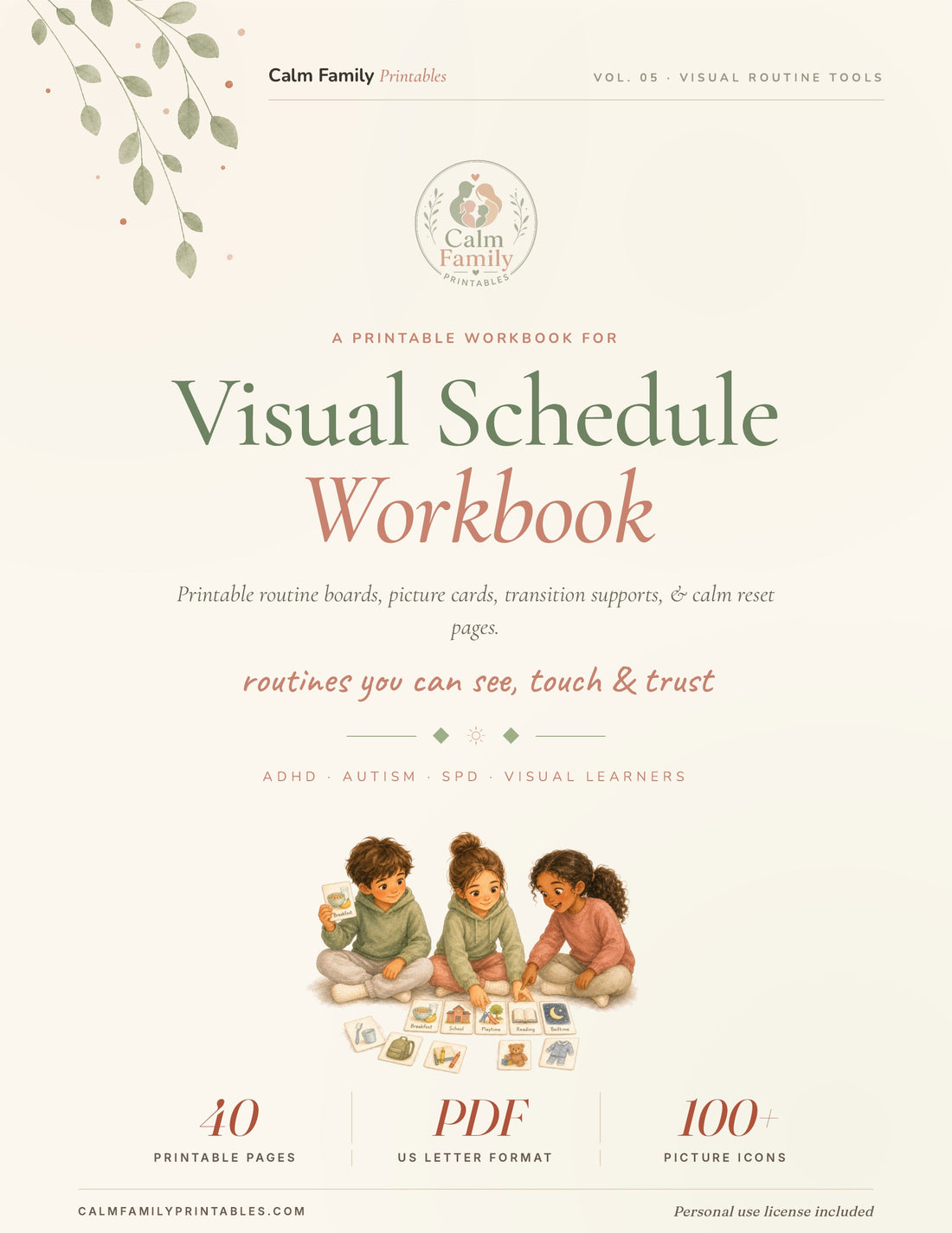
If you want all 5 components in one ready-to-use printable system, that's exactly what our Visual Schedule Workbook is. 100+ printable picture cards, customizable templates for daily/morning/bedtime routines, a "first-then" board, and a parent guide for introducing it to your child.
Shop the Visual Schedule Workbook (15% off with code WELCOME15)
The 6 Types of Visual Schedules
1. The Full Day Schedule
Top to bottom: wake up, breakfast, school, after school, dinner, bath, bed. Best for kids 4 and up who can handle seeing the whole day at once.
2. The Morning Routine Board
Just the morning sequence: brush teeth, get dressed, eat breakfast, shoes, go. Best for ages 3 to 8. Lives in the kid's bedroom or kitchen.
3. The Bedtime Routine Board
The wind-down sequence: bath, pajamas, brush teeth, books, sleep. Most underrated type. It can help bedtime feel calmer and more predictable.
4. The First-Then Board
Two cards only: "First X, then Y." The minimum viable visual schedule. Best for toddlers, kids in dysregulation, and quick transitions. ("First socks, then iPad.")
5. The Choice Board
Four to six options laid out visually. Kid points to what they want next. Best for kids with limited language or those struggling to articulate preferences.
6. The Visual Calendar
For older kids, ages 8 and up. A weekly view with school, activities, family events. Helps build time awareness and can cut down on "but you didn't tell me" complaints.
Most families end up using 2 or 3 of these, not all 6. Start with one. Add others only if needed.
Age-by-Age Guide
Toddlers (2-3 years)
Use real photos. Keep it short: 3 to 5 cards maximum. First-then board is often the best format at this age. Walk your toddler through the sequence by touching each card as you describe it. Don't expect them to use it independently; they're learning the concept of "next."
Preschoolers (4-5 years)
Now they can handle a morning routine board with 5 to 8 cards. Use icons or simple drawings (they're starting to decode symbols). Have them help move the cards as activities are completed. Praise the process, not the speed.
Early School Age (6-8 years)
The sweet spot. Full day schedules work. They can read short words, so add labels under the icons. This is also the right age to introduce a weekly visual calendar so they start understanding "today, tomorrow, next week."
Older Kids (9-12 years)
Move to a more grown-up format. Whiteboards with magnets. Bullet journals. Wall calendars with dry-erase. Don't keep using kid-style picture cards; they'll resist them. The function is the same, the aesthetic shifts.
Teens (13-17 years)
Most teens use phones or planners as their visual schedule. But for neurodivergent teens, especially during stressful periods, a low-tech wall version still beats apps. The lower the friction to glance at it, the better.
Visual Schedules for Autism, ADHD, and Language Delays
For autistic kids, ADHD kids, and kids with language delays, visual schedules are often more than a nice-to-have. They can work like an accommodation, the same way glasses do for someone with vision differences.
Autistic Kids
Many autistic kids feel more settled with MORE structure, not less, and visual schedules are how you provide that structure without making it feel restrictive. Key adjustments:
- Use real photos when possible (especially for kids with significant differences)
- Include preferred activities and special interest time on the schedule (predictability of GOOD things matters too)
- Use a "change" or "surprise" card to introduce flexibility gradually
- Don't change the schedule format randomly. The schedule's predictability is part of what makes it work.
The Visual Schedule Workbook from Calm Family Printables was built specifically with autistic kids in mind. The founder's own autistic son was the first user. The card design, category organization, and parent guide all came from that house.
ADHD Kids
Many ADHD kids like visual cues but find it hard to stay with one long sequence. Adjustments:
- Break the day into smaller chunks (morning, after-school, evening) rather than one long sequence
- Use timers alongside the schedule for time awareness
- Add reward icons sparingly (not for compliance, for celebration of completed sequences)
- Allow your ADHD kid to physically move the cards. The fidget IS the function.
Language Delays
For kids with limited verbal language, visual schedules can become the bridge to communication. Pair the visuals with AAC, sign, or simple verbal labels. Sometimes the visual schedule becomes the kid's first reliable way to point at what they want next.
How to Use Visual Schedules to Survive Transitions
Transitions are where most parents discover visual schedules. The fight at the end of screen time. The meltdown when leaving the playground. The refusal to come to dinner. All of these are transition problems.
Here is a simple transition routine to try:
- 5 minutes before: Show the schedule. Point to the current activity. Point to the next one. Say "almost done with X. Next is Y."
- 1 minute before: Show again. Add a timer if your kid responds to those.
- At the transition: Move the card. Don't lecture. The card moving is the cue. "Time for Y."
- If meltdown: Don't argue with the meltdown. Point at the schedule. "I know. I see the schedule is changing. It's hard. The next thing is Y." Calm presence. Wait.
Keep it consistent and give it time. Some families notice a change within days. Others take longer, and that's okay.
8 Common Mistakes That Backfire
- Making it too complex. A 20-card schedule overwhelms most kids. Start with 5.
- Using it as a behavior chart. Adding rewards/consequences turns it into punishment infrastructure. Don't.
- Inconsistent location. The schedule moves around. Your kid can't find it. They stop checking it.
- No "done" mechanism. Without moving or marking cards, your kid misses the small satisfaction of finishing and the visual progress.
- Giving up after a week. Visual schedules often take a few weeks to become a habit, so it is worth sticking with one past the first week.
- Skipping the practice phase. Walking your kid through the schedule once or twice in calm moments matters more than 50 reminders in dysregulated moments.
- Pinterest aesthetics over function. If the schedule looks gorgeous but takes 20 minutes to update, it won't get updated.
- Forcing eye contact while you explain it. Especially for autistic kids. Just point and narrate. Looking at the schedule IS the engagement.
Frequently Asked Questions
How old should my child be to use a visual schedule?
Start as young as 18 months with first-then boards. Full daily schedules become useful from age 3. There is no upper age limit; teens and adults use visual schedules under various names (planners, bullet journals).
What if my child ignores the schedule?
Three possibilities: it's too complex, the timing/practice phase was skipped, or they don't believe it's real yet. Reduce to 3 cards. Walk through it together in calm moments. Stick with it for 3 weeks. If still no traction, the format is probably wrong (try photos vs. icons, vertical vs. horizontal, different location).
Do I need to update the schedule every day?
For most kids, no. The same routine cards stay up. You only move them as activities are completed. For older kids or kids with chaotic weekly schedules, daily updates help. Most families do "set up once Sunday, run all week."
Picture cards or photo cards: which is better?
Real photos for under-3, kids with significant cognitive differences, or kids who don't decode symbols yet. Icon/illustration cards for everyone else. Some kids respond to one and not the other. Try both.
Can I use a visual schedule alongside a calm down corner?
Yes. They work together beautifully. The schedule can make many transitions easier. The calm down corner is there for the hard moments that still happen.
Do I need to buy printables to make this work?
No. You can DIY. The reason families use printables is to save the 10-20 hours of design and laminating work, keep the look consistent (which many autistic kids appreciate), and get a ready-made system. Optional, not required.
What if my partner won't use it?
This is a common reason visual schedules fail. The schedule needs to be a household tool, not a one-parent tool. If your partner won't engage with it, the kid learns that compliance with the schedule is optional, and the system breaks. Have the conversation about why it matters before you buy the cards.
The Bottom Line
A visual schedule is not Pinterest decor. It's a structural change in how your house communicates expectations to your kid. Done well, it can make transitions easier, help your kid feel more independent, and leave you a little less exhausted by 7pm.
Start simple. Use it consistently. Practice it in calm moments. Stick with it past the awkward weeks. A kid who learns to follow a visual schedule at 4 is already practising the kind of planning they might one day do with a planner of their own.
The Visual Schedule Workbook
If you want to skip the design work and get straight to using a visual schedule, our printable Visual Schedule Workbook has 100+ picture cards (morning, self-care, school, bedtime, movement, choice, more), customizable templates for daily/morning/bedtime routines, a first-then board, and a parent guide for introducing it to your child.
Designed by an autism mom for her own son before it was ever sold to anyone else.