
Coping Skills for Kids: 30 Simple Ideas to Try Tonight
· 8 min read · Updated
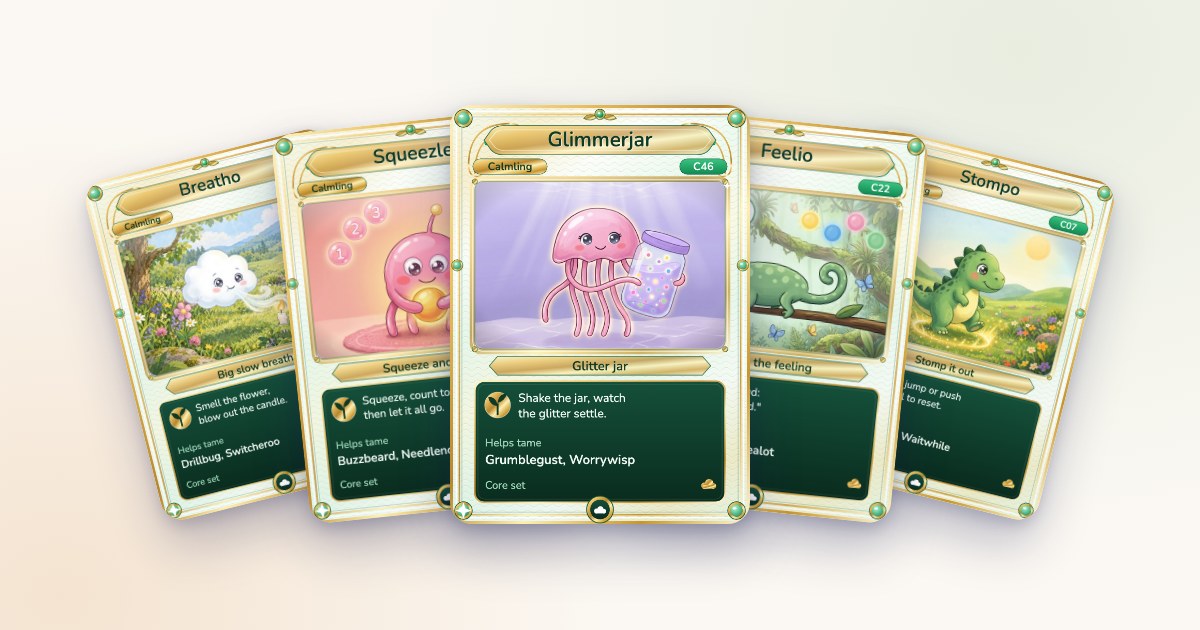
When your child is in the middle of a big feeling, "calm down" hardly ever lands. What helps more is having a few simple things they already know how to do. Those are coping skills: small, practical moves a child can reach for when everything feels too big.
This list has 30 ideas, grouped into breathing, moving, sensory, words and thinking. Each one comes from our Calmlings cards, where a Calmling is a calming move and a Wobble is a tricky moment, like the dentist or a long wait. You don't need the cards to use any of these ideas. Pick two or three to try tonight.
What are coping skills for kids?
Coping skills are the things we do to get through a hard moment. Adults have them too: a walk around the block, a cup of tea, a chat with a friend. Children need the same kind of toolkit, just simpler and more physical.
A good coping skill for a young child is short, easy to remember and doable almost anywhere. It won't make the feeling disappear, but it gives your child something to do while the feeling passes.
How do you teach coping skills to a child?
- Practise when things are calm. A breathing game at breakfast is far easier to learn than one mid-meltdown.
- Do it with them. Children copy what they see. If you take a big slow breath when you're frazzled, they notice.
- Keep the menu small. Three to five favourites is plenty.
- Offer, don't insist. "Would stomping or squeezing help right now?" goes down better than "Do your breathing."
- Talk about it afterwards. Once everyone has settled, ask which move helped.
30 simple coping skills for kids
Breathing coping skills
Breathing is the easiest skill to carry around. It needs no props, and nobody else has to notice. Keep it to three or four slow breaths, and stop if your child feels dizzy.
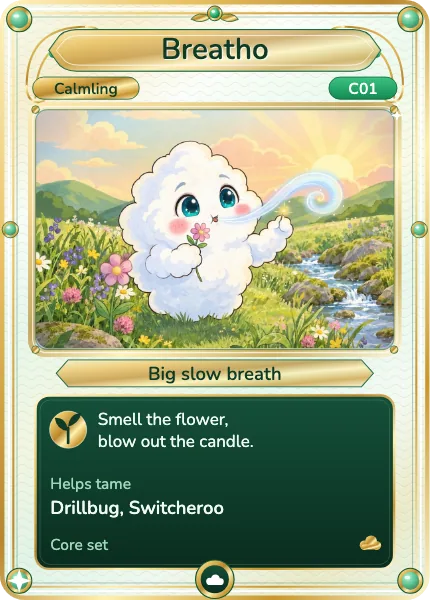
1. Big slow breath. Breatho's card says "Smell the flower, blow out the candle." Holding up one finger as the candle gives little ones something to aim at.
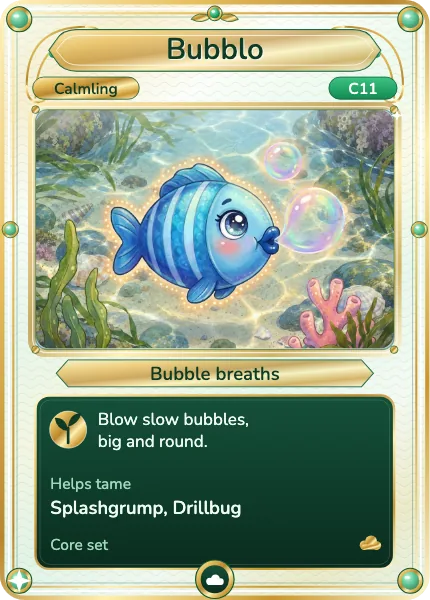
2. Bubble breaths. Bubblo's move is "Blow slow bubbles, big and round." Real bubbles work in the bath or the garden. Pretend ones work in the car.
3. Rainbow breath. Prismpuff says "Breathe in each colour of the rainbow." Say one colour on each breath in: red, orange, yellow and so on.
4. Finger breathing. Tracetail's move is "Trace your fingers, breathe in and out." Breathe in as you trace up a finger and out as you trace down.
5. Star breathing. Starfishy says "Trace a star as you breathe slowly." Draw a star in the air or on paper, one breath for each line.
6. Pinwheel breath. Whirlywind's move is "Blow a pinwheel round and round." A paper windmill turns the out-breath into something your child can see.
 CalmlingsStarfishyUnlock every cardUnlock
For something to follow on screen, try our free Breathe with Breatho page together.
Moving coping skills
Some feelings are too fizzy to sit still with. Moving gives that energy somewhere to go.
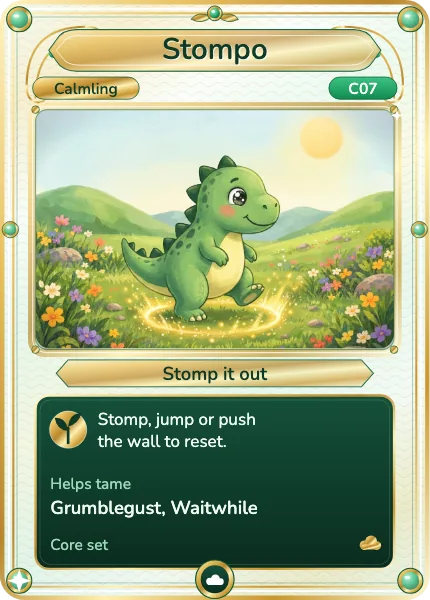
7. Stomp it out. Stompo's card says "Stomp, jump or push the wall to reset." Stomp on the spot together.
8. Shake it out. Wigglewag's move is "Shake your arms and legs, then freeze!" The freeze at the end is the settling part, and children love it.
9. Stretch tall. Stretchy says "Reach up to the sky, then touch your toes." Good for rushed mornings.
10. Slow motion. Slowmo's move is "Move super slowly, like a sleepy sloth." It's hard to stay cross while being a sloth.
11. Bounce it out. Bouncebun says "Bounce on a big ball ten times." Count the bounces out loud. No ball? Small jumps on the spot are fine.
12. Heavy helper. Heftyhog's move is "Carry something heavy for a grown-up." A basket of washing or a pile of books gives a busy body a job.
13. Calm walk. Strollow says "Take a slow walk with a grown-up." Even a lap of the garden or a trip to the letterbox can shift the mood.
 CalmlingsWigglewagUnlock every cardUnlock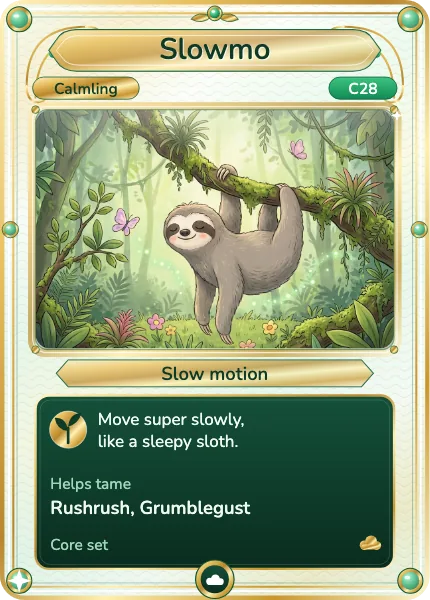
Sensory coping skills
Touch, sound, taste and smell can all help a child settle. Watch which sense your child reaches for.
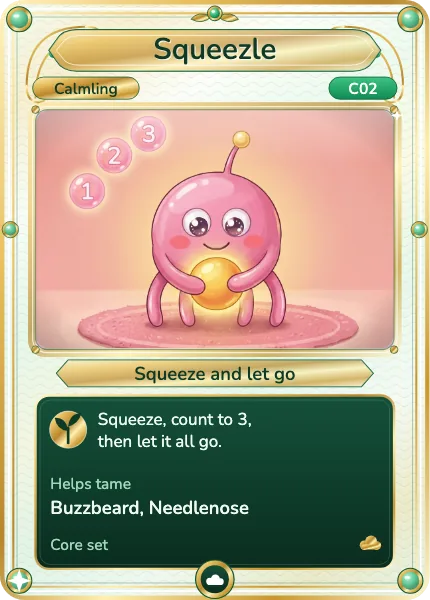
14. Squeeze and let go. Squeezle's card says "Squeeze, count to 3, then let it all go." Use a stress ball, a pillow or two tight fists.
15. Quiet ears. Hushpup's move is "Headphones on when sounds get too big." Handy for school assemblies, hand dryers and busy shops.
16. Heavy blanket. Blanketbear says "Rest under a heavy, cosy blanket." A thick doona does the job. Keep it below your child's chin, and let them wriggle out whenever they like.
17. Slow sips. Sippy's move is "Take three slow sips of cool water." Easy in the car or a waiting room.
18. Squish dough. Doughby says "Squish and roll some play dough." Keep a small tub in your calm-down basket.
19. Glitter jar. Glimmerjar's move is "Shake the jar, watch the glitter settle." Fill a clear plastic jar with warm water, clear glue and glitter, then glue the lid on tight.
20. Calm smell. Scentle says "Smell something nice, like a flower." A sprig from the garden, a tea bag or a favourite hand cream all work.
 CalmlingsDoughbyUnlock every cardUnlock
 CalmlingsGlimmerjarUnlock every cardUnlock
Words coping skills
Words help children turn a big, messy feeling into something they can share.
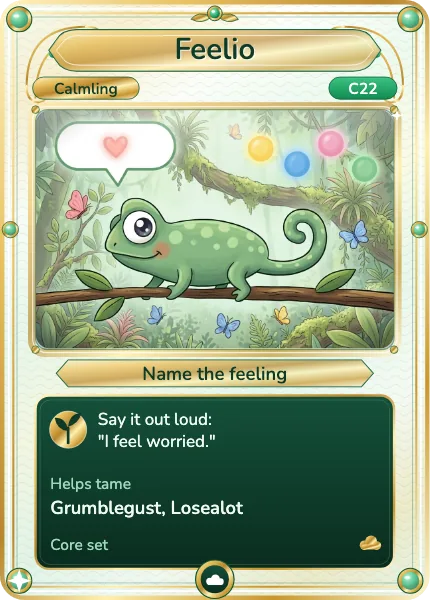
21. Name the feeling. Feelio's card says 'Say it out loud: "I feel worried."' Swap in any feeling word. Our Feelings Friends cards add a "How big? 1 to 5" scale, so a child can say, "I'm angry, and it's a 4."
22. Break please. Breakbeak's move is "Use your words to ask for a little pause." Agree on a simple phrase together, like "I need a minute."
23. Brave words. Bravely says 'Say it strong: "I can do hard things."' Useful before a needle, a new class or a swimming lesson.
24. Tell someone. Chatterbird's move is "Tell a grown-up how you feel." Talk through which grown-ups your child can go to at home and at school.
25. Three good things. Gladsy says "Name three good things about today." A lovely one for the dinner table or the drive home.
 CalmlingsBravelyUnlock every cardUnlock
 CalmlingsChatterbirdUnlock every cardUnlock
Thinking coping skills
Thinking skills give a busy mind something steady to hold on to.
26. Count it down. Countalot's card says "Count slowly to 10, then back down to 1." Use fingers so there's something to see as well as say.
27. Spot five things. Spotto's move is "Name 5 things you see and 4 you can hear." It's a kid-sized take on the 5-4-3-2-1 game, and handy in crowded places.
28. Happy place. Dreamdrift says "Close your eyes and imagine a calm place." Build the place together on a calm day, such as the beach or a treehouse, so it's ready when needed.
29. First, then. Planda's move is "See what comes first and what comes next." Draw two boxes: first shoes, then park.
30. Draw it out. Doodlephant says "Draw how you feel, then colour it calm." Scribbles count. Some children draw the feeling as a storm, then colour sunshine over the top.
Which coping skills help with anger, worry and waiting?
There's no single right answer, but some pairs are a good place to start. In the Calmlings game, a child "tames" a Wobble with a Calmling's move. Here are a few pairs from the cards:
- Big angry feelings: Grumblegust is tamed by Stompo or Wigglewag. Move first, talk later.
- Worried thoughts: Worrywisp is tamed by Flutterhug ("Cross your arms and tap, tap, tap slowly.") or Wigglewag.
- Waiting: Waitwhile is tamed by Tickatock ("The timer shows how long until it's done.") or Fidgetfox ("Keep your hands busy with a fidget toy.").
- The dentist: Drillbug is tamed by Breatho or Dreamdrift.
Use these as starting points, and go with whatever suits your child.
What about mindfulness, worries and saying thanks?
The Complete Collection also has painted storybook cards, each with one small thing to try. They sit outside the 30 above. Here are a few of them, in the cards' own words.
- Noticing games, for a mindful minute. Five senses: "See, hear, touch, smell and taste." Leaf count: "See 5, hear 4, touch 3, then breathe." Jungle listen: "Close your eyes, name three sounds." Colour spotter: "Spot one thing of every colour." Zoom in: "Pick one thing. Look very close." Slowest thing: "Spot the slowest thing moving." Texture trio: "Find smooth, bumpy, soft things." Pebble hold: "Hold a smooth pebble, breathe slowly." Sound catcher: "Hear a sound? Catch it in the air!"
- For worries. Worry shelf: "Pop the worry on a pretend shelf." Shrink it: "Squash a pretend worry small." Silly voice: "Say the worry in a silly voice." Thought check: "Ask: is that thought really true?" Spirit float: "Sit still, let each worry float away." Soar above: "Imagine soaring high above the worry."
- For saying thanks and looking forward. Thank-you heart: "Thank one person from today." Today's star: "Name one thing you learned today." Look forward: "Name one thing you can't wait for." Happy memory: "Remember a time you laughed a lot." Love count: "Count the people who love you." Kind word: "Say one kind thing to someone."
Try one at a time, on an easy day first.
Where should we keep coping skill ideas at home?
Coping skills are easier to use when a child can see them. Stick a few on the fridge, pop some in a calm-down basket or keep a set in the car. Our guide on how to set up a calm-down corner has more ideas, and there's more on helping kids with big feelings too.
Every child has hard days, and that's normal. If worries or big feelings seem to be getting in the way of everyday life for a while, a chat with your GP or child's doctor is a good next step.
All 30 ideas as printable cards
Every idea in this list is a Calmlings card you can print at home. Eighteen of them are in the Calmlings Starter Set (US$5), which has 28 Calmlings plus Wobbles and Feelings Friends. For all 53 Calmlings and every other card, 1000 in all, the Calmlings Complete Collection (US$29.99) has the lot. You can browse every card in the Calmlings gallery, or see every calming move on one page, sorted by type, on our coping skills cards page. Nine of them are free: free calm down cards.