
Emotions Activities for Kids: Name, Rate and Calm Feelings
· 7 min read · Updated
One minute your child is building a tower. The next, it has crashed, and so have they. Most of us say "calm down", and most young children can't do that on cue. Not yet. What can help is practising a few small skills on the easy days, so they're easier to reach for on the hard ones.
These emotions activities for kids aged about 3 to 10 build three of those skills: naming the feeling, noticing how big it is, and trying a calming move. Most need nothing more than paper, a pen and five minutes. We'll show where our Calmlings Feelings Friends cards fit in, but you can start every idea below tonight with what you already have at home.
Why does naming feelings help kids?
A feeling without a name is just a storm inside. A feeling with a name is something your child can point to, talk about and ask for help with. Naming it won't make it vanish. It does give your child a way to tell you what's going on, instead of only showing you.
It gives you a clue, too. "I'm scared" needs something different from "I'm cross" or "I'm tired", even when all three look like tears on the kitchen floor.
How do you teach a child to name their feelings?
Keep it playful and short. Little and often beats one big lesson.
1. Feelings charades
Take turns acting out a feeling with your face and body while everyone else guesses. Start with the big four: happy, sad, angry and scared. Once those are easy, add trickier ones like proud, jealous or embarrassed. A grown-up taking a turn, and hamming it up, is half the fun.
2. The body clue hunt
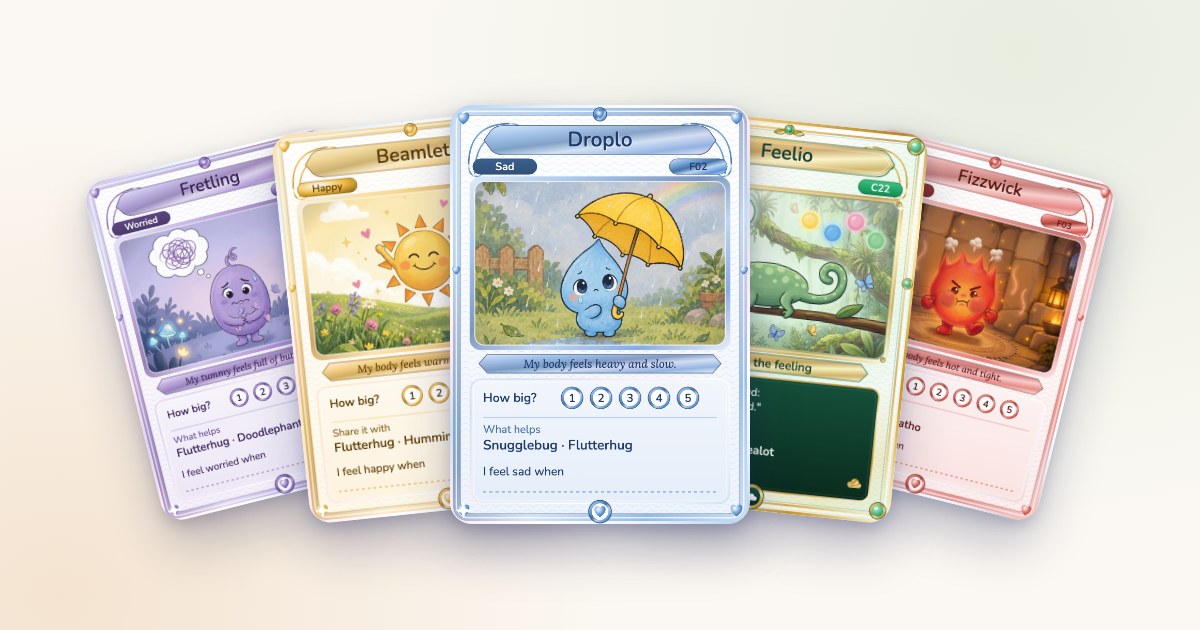
Feelings often show up in the body before children have words for them. Ask, "Where do you feel it?" Each Feelings Friend card has a body clue to get you started. Fretling, the worried one, says "My tummy feels full of butterflies." Fizzwick, the angry one, says "My body feels hot and tight." Droplo, the sad one, says "My body feels heavy and slow." Ask your child whether their body agrees, or feels different. Both answers are useful.
3. Story detectives
Pause a picture book or a cartoon and ask, "How do you think she feels? What's the clue?" It's much easier to spot feelings in someone else first, and it builds the same skill.
4. Say it out loud
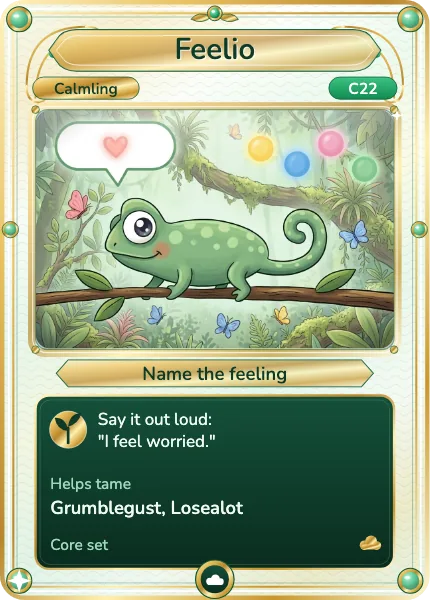
Feelio is the Calmling for this one. The move is "Name the feeling", and the card says: Say it out loud: "I feel worried." Practise the sentence with different feelings, in silly voices and in whispers. Then use it yourself, in real life: "I feel frustrated. The car won't start. I'm going to take a big breath." Children often copy what we do more than what we say.
5. Finish the sentence
Every Feelings Friend card ends with a sentence starter, like "I feel happy when" or "I feel lonely when". Pick one at dinner or in the bath and take turns finishing it. There are no wrong answers.
 FeelingsBeamletFree in the chart packFree
 FeelingsDroploFree in the chart packFree
 FeelingsFizzwickFree in the chart packFree
 FeelingsFretlingFree in the chart packFree
What is a feelings scale for kids?
A feelings scale is a simple way to show how big a feeling is. Every Feelings Friend card has one: "How big?" with the numbers 1 to 5. Our free feelings chart has the same 1 to 5 strip, ready to print.
- 1 is a tiny flicker. You barely notice it.
- 3 is right in the middle. You can feel it, and you can still think.
- 5 is as big as it gets. It fills you up from your toes to your ears.
Why bother with numbers? Because the size changes what helps. A worried 2 about a spelling test might just need a chat and a hug. A worried 5 during a thunderstorm needs you close, a quiet voice and a calming move. The talking can wait.
No cards? No problem. Use fingers (one finger up to a whole hand), draw a staircase with five steps, or ask your child to show you with their arms: hands close together for small, arms stretched wide for huge.
Try the "size it up" game
Read out little moments and let your child hold up fingers for how big the feeling would be. Your ice cream falls on the ground. A friend can't come over to play. You find a coin in your pocket. You lose at a board game. There are no right answers, and you'll probably learn a lot about your child.
Happy feelings have sizes too. Zippity, the excited Feelings Friend, has "If it gets too big" printed on the card, next to two Calmlings: Slowmo ("Move super slowly, like a sleepy sloth.") and Breatho. A 5 of excitement right before bed can be just as hard to settle as a 5 of anger.
What calming activities help with big feelings?
Once the feeling has a name and a size, it's time for a calming move. In the Calmlings game, those moves are the Calmlings themselves. Each Feelings Friend card names two Calmlings to try, so you're not guessing in the heat of the moment.
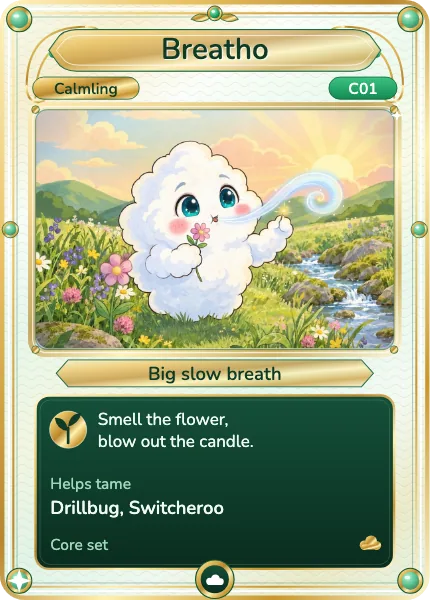
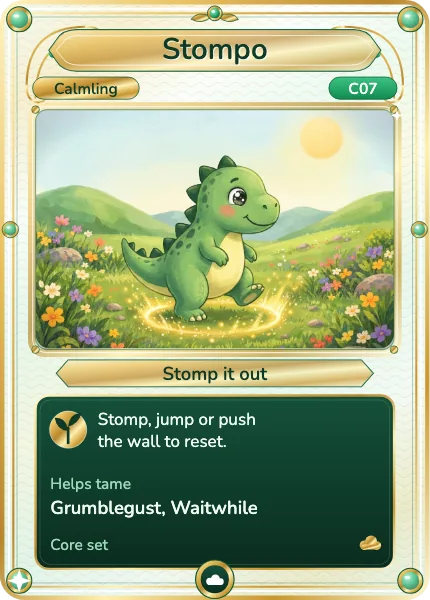
- Angry: Fizzwick suggests Stompo ("Stomp, jump or push the wall to reset.") and Breatho ("Smell the flower, blow out the candle.").
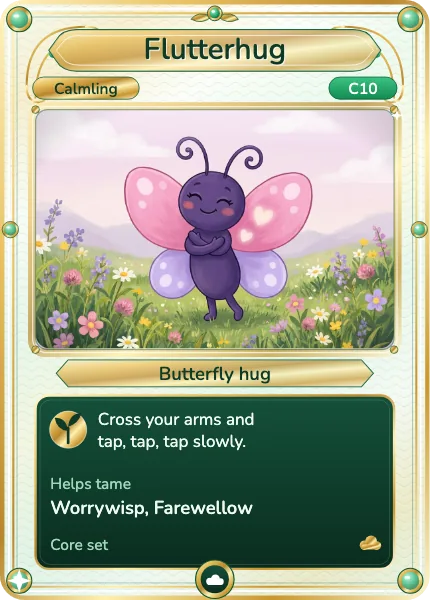
- Worried: Fretling suggests Flutterhug ("Cross your arms and tap, tap, tap slowly.") and Doodlephant ("Draw how you feel, then colour it calm.").
- Sad: Droplo suggests Snugglebug ("Hug your soft toy, nice and snug.") and Flutterhug.
- Frustrated: Knotsy suggests Squeezle ("Squeeze, count to 3, then let it all go.") and Breakbeak ("Use your words to ask for a little pause.").
Practise these when everyone is calm, so the moves feel familiar. In a big moment, offer just two choices: "Stomp it out, or big slow breath?" Afterwards, check the size again. Going from a 4 to a 2 is a real win, and it's worth saying so out loud.
If your child likes something to watch, our free Breathe with Breatho page paces a slow breath on screen, in and out.
How do you play a feelings game with the cards?
Here's a ten-minute routine that fits after school or before bath time.
- Lay out four to six Feelings Friends, face up.
- Your child picks the one that fits today. If they're not sure, pick one yourself and share a moment from your day.
- Read the body clue together. Is that where they feel it?
- Point to the How big? scale. What number is it?
- Look at the two Calmlings the card suggests and try one of their moves together.
- Check the number again.
- Finish the sentence on the card.
The Starter Set also has Wobbles, the tricky moments, and your child "tames" each one with a Calmling's move. Grumblegust, the Wobble for big angry feelings, is tamed by Stompo and Wigglewag. Losealot, for losing a game, is tamed by Feelio and Breatho. It turns practice into a game rather than a lesson.
How do you help a 3-year-old with big emotions?
Keep it small and physical. Stick to four feelings: happy, sad, angry and scared. Use pictures rather than words, fingers rather than numbers, and moves they can do with their whole body, like stomping or a big squeezy hug. Name feelings for them as they happen: "You're cross. The tower fell down." Our guide to a calm down corner for 3-year-olds has more ideas for this age.
What about older kids, 6 to 10?
Older children are often ready for finer shades. There's a big difference between angry and frustrated, sad and disappointed, shy and embarrassed. They can write their sentences in a notebook, draw a feelings map of their body, or rate their day at dinner. The Complete Collection adds 13 more Feelings Friends, from overwhelmed, disappointed and confused to shy, grateful and sorry.
 FeelingsWhirlwhelmUnlock every cardUnlock
 FeelingsDroopsyUnlock every cardUnlock
 FeelingsMuddlepuffUnlock every cardUnlock
 FeelingsGlowheartUnlock every cardUnlock
What if my child won't talk about feelings?
That's very common. A few things can make it easier:
- Talk side by side, not face to face. The car, a walk or drawing together all feel less like an interview.
- Let them point to a card or a face instead of finding words.
- Let a teddy do the talking: "How is Bear feeling today?"
- Wait until the storm has passed. Nobody can chat at a 5.
- Keep naming your own feelings. They're listening, even when it doesn't look like it.
If big feelings are very frequent, very hard to settle, or getting in the way of everyday life, have a chat with your GP or your child's doctor.
For more ideas, read our guide on how to help kids with big feelings, or see how to set up a calm down corner where your feelings cards can live.
Would you like the cards ready to print?
The Calmlings Starter Set is US$5 and has 61 cards to print at home: Feelio and 27 more Calmlings, 17 Wobbles, the first 13 Feelings Friends (each with a body clue and a How big? 1 to 5 scale) and 3 extras. You can meet every card in the Calmlings gallery first, or see all the emotion cards on one page.